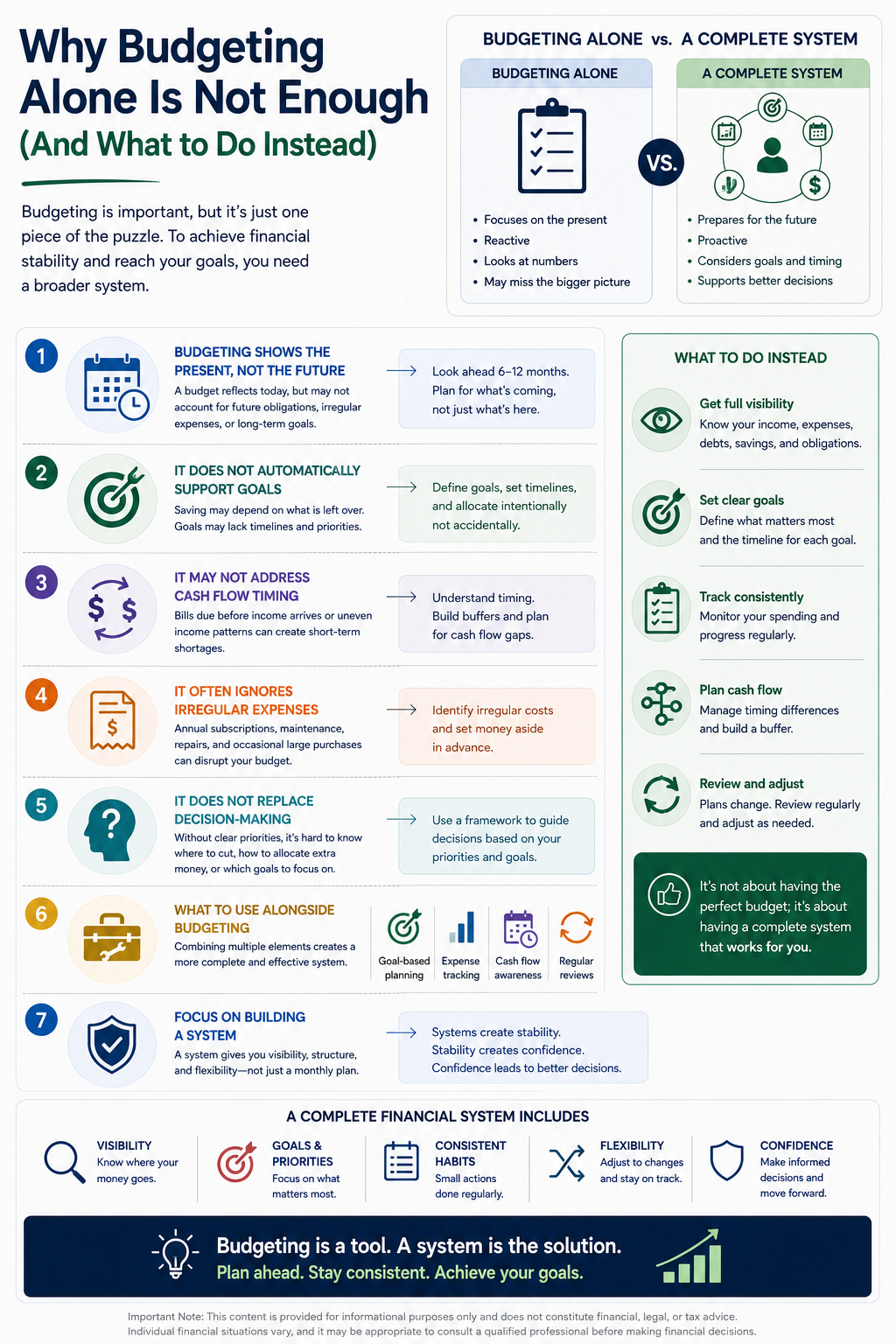
Budgeting is often seen as the foundation of personal finance. While it can be a useful tool, relying on budgeting alone may not provide the full picture needed to manage money effectively.
Many financial challenges are not caused by the absence of a budget, but by the lack of a broader system.
1. Budgeting Shows the Present, Not the Future
A budget typically reflects your current income and expenses.
However, it may not fully account for:
- Future obligations
- Irregular expenses
- Long-term financial goals
Without considering these factors, a budget can give a false sense of stability.
2. It Does Not Automatically Support Goals
Having a budget does not guarantee progress toward financial goals.
For example:
- Saving may depend on what is left over
- Goals may not have clear timelines
- Priorities may not be defined
A structured plan is needed to connect daily spending with long-term objectives.
3. It May Not Address Cash Flow Timing
Even if your budget looks balanced, timing can still create problems.
Situations such as:
- Bills due before income arrives
- Uneven income patterns
can lead to short-term shortages, even when overall numbers appear manageable.
4. It Often Ignores Irregular Expenses
Many budgets focus on recurring monthly costs, but overlook less frequent expenses.
Examples include:
- Annual subscriptions
- Maintenance or repairs
- Occasional large purchases
If these are not planned for, they can disrupt your financial balance.
5. It Does Not Replace Decision-Making
A budget is a tool, not a decision-making system.
Without clear priorities, it can be difficult to decide:
- Where to reduce spending
- How to allocate extra money
- Which goals to focus on
A broader framework helps guide these choices.
6. What to Use Alongside Budgeting
To improve your financial system, consider combining budgeting with:
- Goal-based planning
- Expense tracking
- Cash flow awareness
- Regular reviews
These elements work together to create a more complete structure.
7. Focus on Building a System
Instead of relying on a single method, aim to build a system that includes:
- Visibility of your finances
- Clear goals and priorities
- Consistent habits
- Flexibility to adjust
This approach can provide more stability than budgeting alone.
Final Thoughts
Budgeting can be a useful starting point, but it is most effective when combined with other elements of financial planning. A structured system that includes goals, tracking, and regular adjustments can lead to more consistent and informed decisions.