• Home
  • How It Works
  • My Account
    • Profile
    • Dashboard
  • F.A.Q
  • Pricing
  • Legal
    • Cookie Policy
    • Refund and Cancellation Policy
    • Terms of Service
    • Privacy Policy
  • Articles
Menu
  • Home
  • How It Works
  • My Account
    • Profile
    • Dashboard
  • F.A.Q
  • Pricing
  • Legal
    • Cookie Policy
    • Refund and Cancellation Policy
    • Terms of Service
    • Privacy Policy
  • Articles
Log In
Lost password? Register

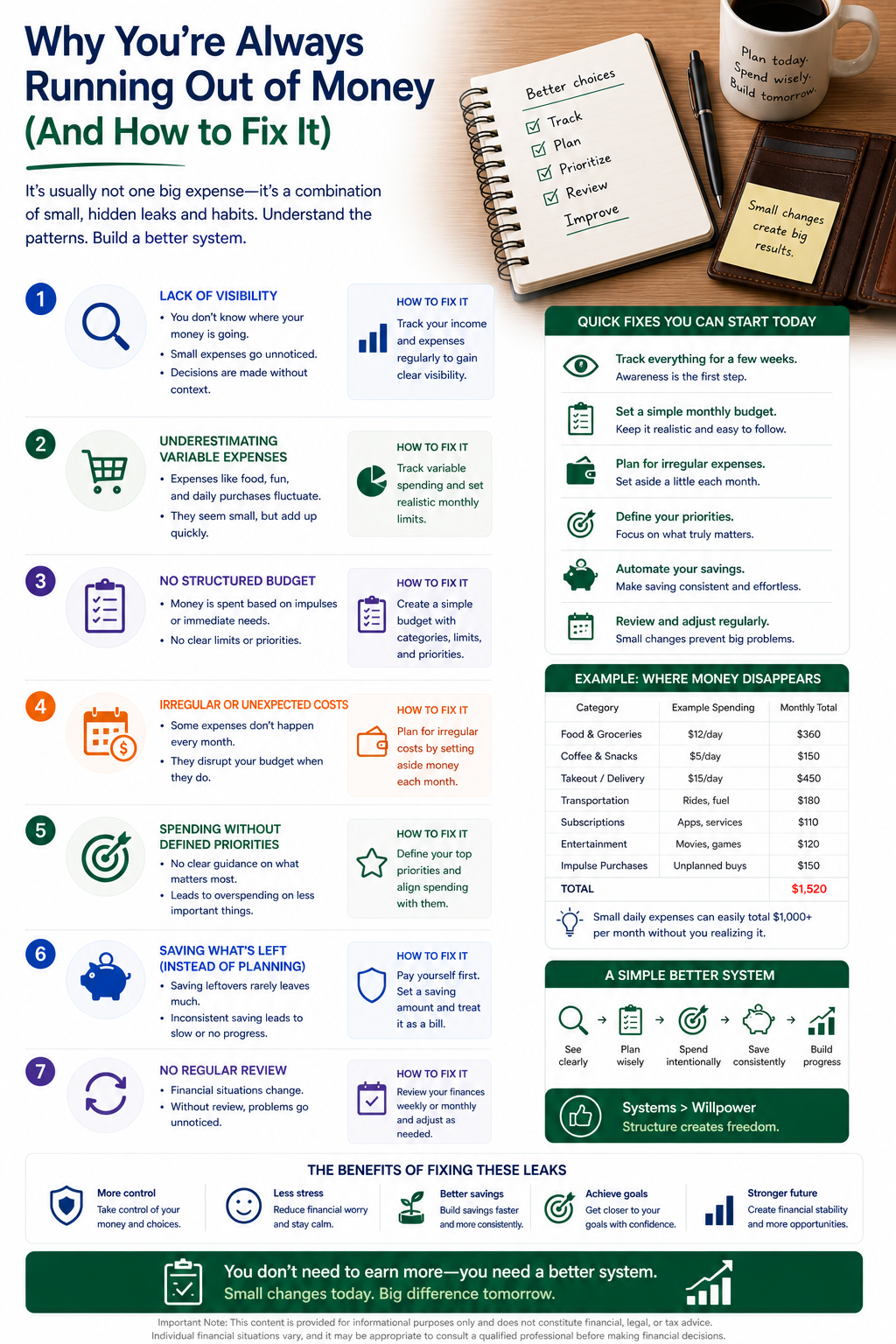
Why You’re Always Running Out of Money (And How to Fix It)

Running out of money before the end of the month is a common experience. In many cases, it is not caused by a single large expense, but by a combination of smaller, less visible factors.

Understanding these patterns is the first step toward improving your financial situation.

1. Lack of Visibility

One of the most common reasons is simply not knowing where your money is going.

Without a clear overview:

  • Small expenses go unnoticed
  • Spending patterns remain hidden
  • Decisions are made without context

Improving visibility through tracking can often reveal issues quickly.

2. Underestimating Variable Expenses

Fixed costs are usually predictable, but variable expenses can fluctuate significantly.

Examples include:

  • Food and groceries
  • Entertainment
  • Daily purchases

These categories may seem manageable individually but can add up over time.

3. No Structured Budget

Without a structured plan, money tends to be spent based on immediate needs or impulses.

A simple budget provides:

  • Spending limits
  • Clear priorities
  • Better control over decisions

Even a basic structure can make a noticeable difference.

4. Irregular or Unexpected Costs

Certain expenses do not occur every month but still affect your overall finances.

These may include:

  • Annual subscriptions
  • Maintenance costs
  • Occasional large purchases

If these are not accounted for, they can disrupt your monthly balance.

5. Spending Without Defined Priorities

When there are no clear priorities, it becomes harder to decide how to allocate money.

This can lead to:

  • Overspending in less important areas
  • Insufficient funds for essential needs
  • Difficulty reaching financial goals

Defining priorities helps guide daily decisions.

6. Saving What’s Left (Instead of Planning)

A common approach is to save whatever remains at the end of the month.

However, this often results in little or no savings.

A more structured method is to:

  • Set a planned saving amount
  • Treat it as a regular expense
  • Adjust spending around it

This approach can improve consistency.

7. No Regular Review

Financial situations change, but without regular review, these changes may go unnoticed.

Reviewing your finances periodically helps:

  • Identify issues early
  • Adjust spending patterns
  • Maintain better control

Even a short weekly check can be effective.


Final Thoughts

Running out of money is often the result of multiple small factors rather than a single major issue. By improving awareness, creating structure, and reviewing your finances regularly, it is possible to build a more stable and predictable system over time.

Discover more to take control of your finances.

Previous Next

Important Note

This content is provided for informational purposes only and does not constitute financial, legal, or tax advice. Individual financial situations vary, and it may be appropriate to consult a qualified professional before making financial decisions.
We use cookies on our website to give you the most relevant experience by remembering your preferences and repeat visits. By clicking “Accept All”, you consent to the use of ALL the cookies. However, you may visit "Cookie Settings" to provide a controlled consent.
Cookie SettingsAccept All
Manage consent

Privacy Overview

This website uses cookies to improve your experience while you navigate through the website. Out of these, the cookies that are categorized as necessary are stored on your browser as they are essential for the working of basic functionalities of the website. We also use third-party cookies that help us analyze and understand how you use this website. These cookies will be stored in your browser only with your consent. You also have the option to opt-out of these cookies. But opting out of some of these cookies may affect your browsing experience.
Necessary
Always Enabled

Necessary cookies are absolutely essential for the website to function properly. These cookies ensure basic functionalities and security features of the website, anonymously.

CookieDurationDescription
cookielawinfo-checkbox-analytics11 monthsThis cookie is set by GDPR Cookie Consent plugin. The cookie is used to store the user consent for the cookies in the category "Analytics".
cookielawinfo-checkbox-functional11 monthsThe cookie is set by GDPR cookie consent to record the user consent for the cookies in the category "Functional".
cookielawinfo-checkbox-necessary11 monthsThis cookie is set by GDPR Cookie Consent plugin. The cookies is used to store the user consent for the cookies in the category "Necessary".
cookielawinfo-checkbox-others11 monthsThis cookie is set by GDPR Cookie Consent plugin. The cookie is used to store the user consent for the cookies in the category "Other.
cookielawinfo-checkbox-performance11 monthsThis cookie is set by GDPR Cookie Consent plugin. The cookie is used to store the user consent for the cookies in the category "Performance".
viewed_cookie_policy11 monthsThe cookie is set by the GDPR Cookie Consent plugin and is used to store whether or not user has consented to the use of cookies. It does not store any personal data.

Functional

Functional cookies help to perform certain functionalities like sharing the content of the website on social media platforms, collect feedbacks, and other third-party features.

Performance

Performance cookies are used to understand and analyze the key performance indexes of the website which helps in delivering a better user experience for the visitors.

Analytics

Analytical cookies are used to understand how visitors interact with the website. These cookies help provide information on metrics the number of visitors, bounce rate, traffic source, etc.

Advertisement

Advertisement cookies are used to provide visitors with relevant ads and marketing campaigns. These cookies track visitors across websites and collect information to provide customized ads.

Others

Other uncategorized cookies are those that are being analyzed and have not been classified into a category as yet.

SAVE & ACCEPT