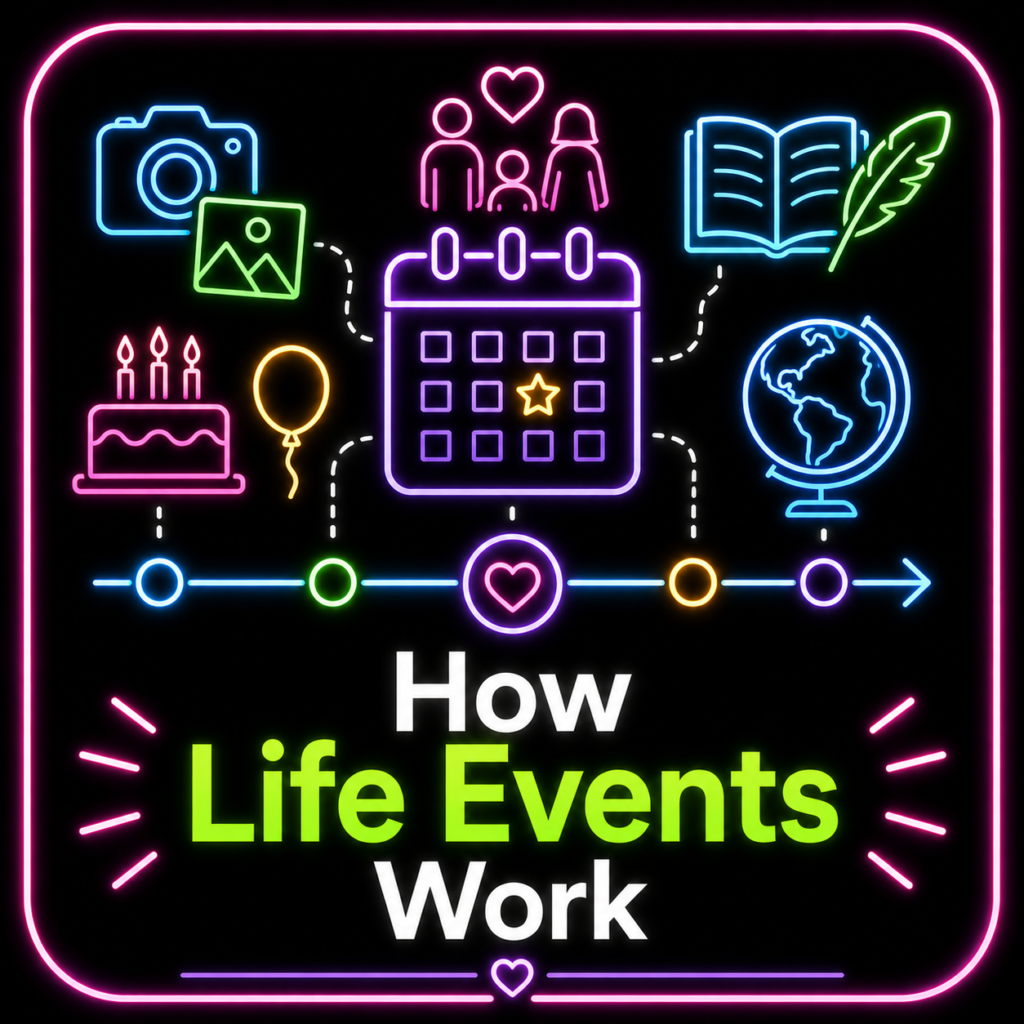
How Life Events Work
Time to Read
Approximately 4 minutes
Best For
Anyone who wants to preserve important memories, organize life events and view the different periods of life from a broader perspective.
You’ll Learn
- Why Life Events is more than a photo album
- How to create memories and timelines
- How periods of life are displayed
- How the timeline helps you better understand your personal history
1. What Is Life Events?
Life is made up of countless moments.
Some last only a single day, while others shape months or even years of our lives.
Life Events was created to help you organize these memories in a visual timeline that allows you to revisit both individual moments and longer periods of your life.
Instead of storing photographs or memories in different places, you can build your own personal history in one organized timeline that continues to grow throughout the years.
2. Why Is It Useful?
Most photo collections only show individual moments.
Life Events goes one step further.
It helps you understand when events happened, how long they lasted and how they relate to other periods of your life.
Looking back at your personal timeline often reveals connections that are difficult to notice when memories are scattered across different albums, devices or years.
Instead of simply remembering events, you begin to see the bigger picture of your own life story.
3. Getting Started
Getting started only takes a few simple steps.
Step 1
Create your first Life Event.
Give it a title and choose whether it represents a single date or a longer period.
Step 2
Choose a cover.
You may use:
- a photograph;
- or a color background.
A meaningful photo is usually the best choice because it makes your timeline easier to recognize at a glance.
Step 3
Add optional information.
For example:
- subtitle;
- memories;
- photo album;
- notes;
- descriptions;
- event type.
These details help preserve the story behind each event.
Your Life Timeline
Create an event.
↓
Choose a date or time period.
↓
Add photos and memories.
↓
Organize your personal timeline.
↓
Continue adding new memories throughout your life.
↓
Watch your personal history grow over time.
4. Everyday Use
Life Events is designed to grow gradually.
Whenever something important happens, simply create a new event.
Some events may last only one day, while others may represent months or even years.
As your collection grows, your timeline becomes a visual overview of your life’s journey.
Instead of searching through thousands of photos, you can navigate directly to the periods that matter most.
5. What Happens Next?
As more events are added, your timeline becomes increasingly meaningful.
You can:
- browse different months and years;
- move forward and backward through time;
- revisit important memories;
- display long periods across multiple months;
- preserve photo collections together with written memories;
- better understand how different stages of your life fit together.
Over time, your timeline becomes much more than a collection of memories.
It becomes a visual story of your life.
6. Everyday Example
Imagine you would like to remember your university years.
Instead of creating dozens of separate events, you create one Life Event covering the entire period.
Each month of those years displays the same event on the timeline.
Within that event you collect photographs, memories and important milestones.
Years later, you can instantly revisit not only individual memories but also appreciate how significant that chapter was in your life.
7. Tips
- Use meaningful cover photos whenever possible.
- Create longer events for major periods of your life.
- Add short notes while memories are still fresh.
- Organize related photos into albums.
- Continue adding events regularly to build a complete personal timeline.
8. Summary
Life Events helps you preserve much more than photographs.
It organizes memories, milestones and longer chapters of your life into a single visual timeline that continues to grow over the years.
By bringing together dates, photographs and personal memories, Life Events allows you not only to remember the past, but also to better understand the journey that has shaped your life.