How Household Planner Works
Time to Read
Approximately 5 minutes
Best For
New users who want to understand how Household Planner works and how to get the most from the platform.
You’ll Learn
- How Household Planner is designed to be used
- How to build your own financial system
- How different features work together
- How the platform becomes more valuable over time
1. What Is Household Planner?
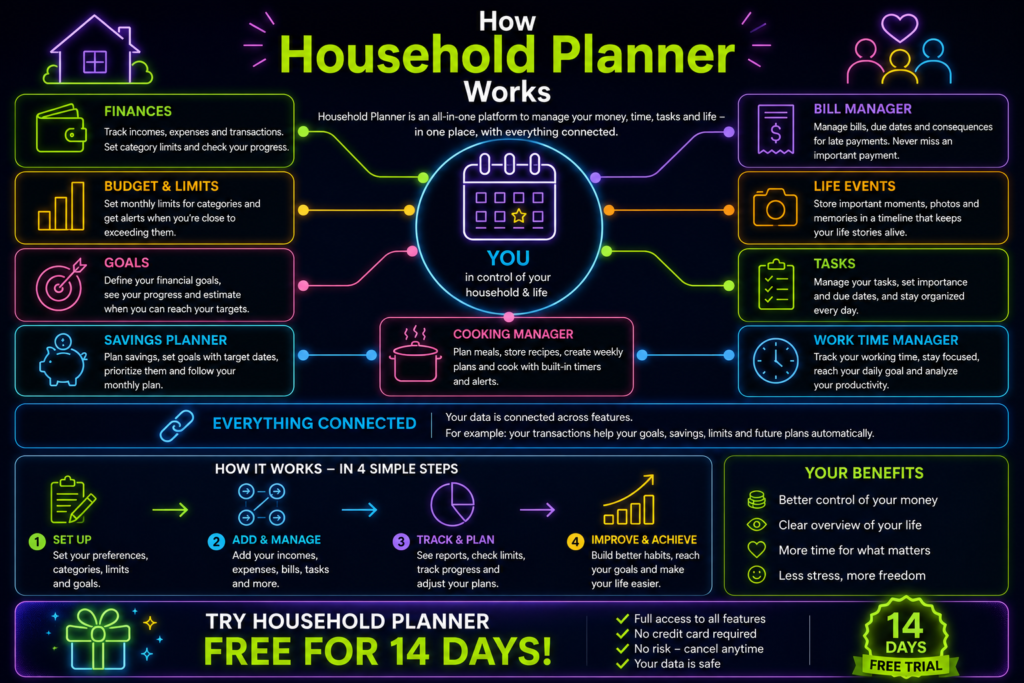
Household Planner is a complete Household & Life Management Platform designed to help you organize your household finances and many other aspects of everyday life within one integrated system.
The platform begins with your household finances because they form the foundation for many other features. As you continue using Household Planner, it gradually becomes much more than a financial application. It grows into a complete household management system that supports planning, organization and long-term decision making.
Whether you simply want a better overview of your everyday finances or you want to actively manage your savings, bills, work schedule and future goals, Household Planner is designed to bring everything together in one place.
2. Why Is It Useful?
The primary purpose of Household Planner is not to analyze your spending habits.
Its main purpose is to present your household finances in a clear, organized and easy-to-understand structure.
Instead of trying to remember where your money went or searching through bank statements and receipts, you always have a complete overview of your household finances.
This organized financial overview makes everyday money management much easier. You can quickly see your income, expenses and financial activity without spending time collecting information from different places.
Once this financial foundation has been built, Household Planner becomes even more valuable by helping you recognize financial patterns, understand your spending behaviour and support better financial decisions based on real data rather than assumptions.
3. Getting Started
Getting started only takes a few simple steps.
Step 1
Create your own income and expense categories.
Unlike many financial applications, Household Planner does not force you to use predefined categories.
Instead, you create a category system that matches your own household and the level of detail you want.
Step 2
Start recording your income and expenses.
Each transaction only takes a few seconds to record.
Every new transaction becomes part of your household’s financial history.
Step 3
Use Household Planner regularly.
The more complete your financial history becomes, the more useful the platform becomes.
Your Journey with Household Planner
Every great household management system begins with a few simple steps.
As you continue using Household Planner, your financial records gradually grow into a complete household management system.
Create Your Categories
Build a category structure that reflects the way your household works.
↓
Record Income & Expenses
Record your everyday financial activity in just a few seconds.
↓
Build Your Financial History
Every transaction becomes part of your growing financial history.
↓
Explore Reports & Statistics
Search, filter and compare your financial information from different perspectives.
↓
Understand Your Financial Habits
Recognize spending patterns and discover opportunities to improve your household budget.
↓
Plan Your Future
Use Goals, Savings Planner and Spending Limits to support better long-term planning.
↓
Manage More Than Just Finances
Expand your experience with Bill Manager, Tasks, Work Time Manager, Cooking Manager and Life Events to organize many aspects of everyday life within one integrated platform.
4. Everyday Use
Using Household Planner quickly becomes part of your daily routine.
Whenever you receive income, record it.
Whenever you spend money, record the transaction in the appropriate category.
Household Planner automatically keeps your financial records organized.
As weeks and months pass, your financial history grows into a valuable source of information that is always available whenever you need it.
5. What Happens Next?
As your financial history grows, Household Planner gradually transforms individual transactions into meaningful information.
You can:
- search and filter transactions;
- compare different categories;
- generate reports;
- view charts and statistics;
- monitor spending limits;
- estimate future financial goals;
- manage savings;
- organize bills;
- and use many other tools built on your financial data.
Instead of seeing thousands of separate transactions, you begin seeing the complete picture of your household finances.
6. Everyday Example
Imagine you have been using Household Planner for six months.
Every salary payment, grocery purchase, utility bill and fuel expense has been recorded.
At the end of the month, instead of wondering where your money went, you simply open Household Planner.
Within seconds you can see exactly how your household budget has been used.
You notice that several small recurring purchases together cost far more than expected.
By making only a few small adjustments, you begin setting aside enough money for your annual holiday.
A few years later, those same regular savings may become part of a much larger financial goal.
7. Tips
- Start with a simple category system and expand it only when necessary.
- Record transactions regularly for the most accurate financial overview.
- Review your reports at least once a month.
- Small recurring expenses often become surprisingly significant over time.
- The longer you use Household Planner, the more valuable your financial history becomes.
8. Summary
Household Planner is much more than a budgeting application.
Its primary purpose is to provide a clear, organized and easy-to-understand overview of your household finances, making everyday financial management simpler and more transparent.
Once this financial foundation has been established, the platform helps you understand your financial history, make better-informed decisions, plan future goals and organize many other aspects of everyday life within one integrated system.